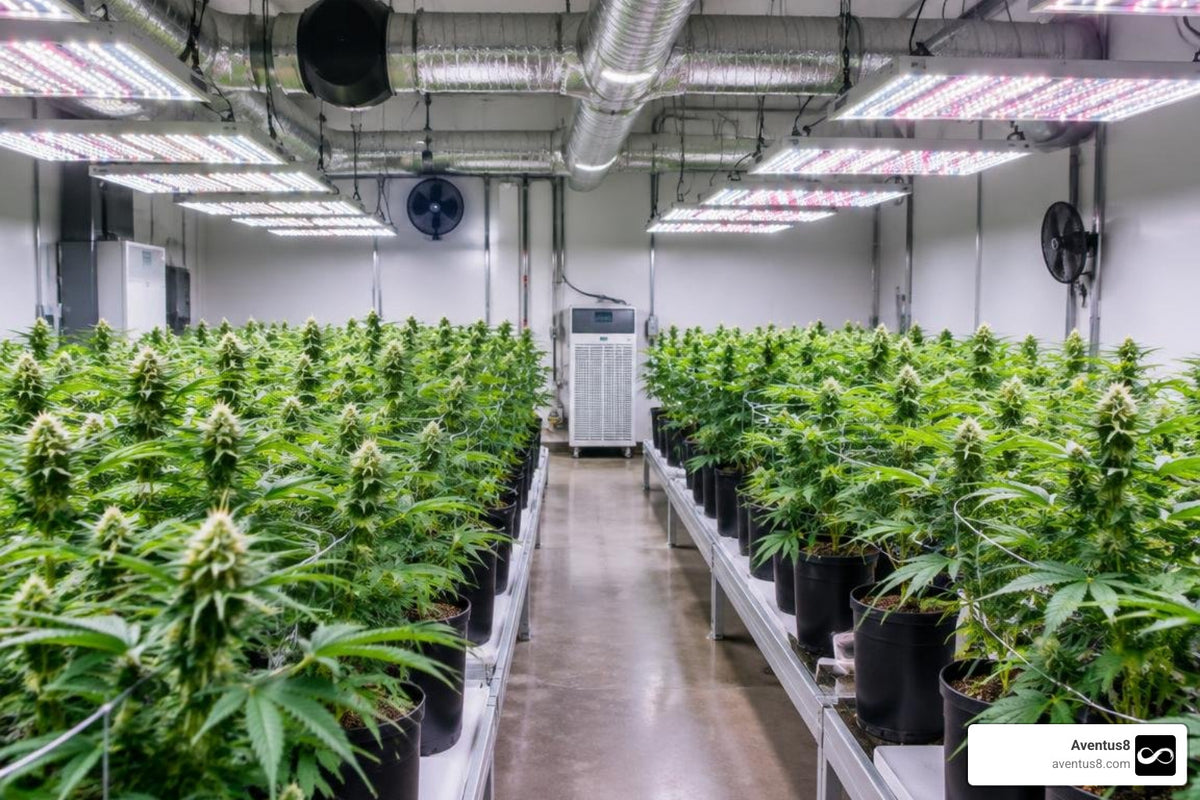
Article: The State-by-State Guide to Delta-9 THC Legality
The State-by-State Guide to Delta-9 THC Legality
Delta-9 THC Is Not Legal the Same Way in All 50 States
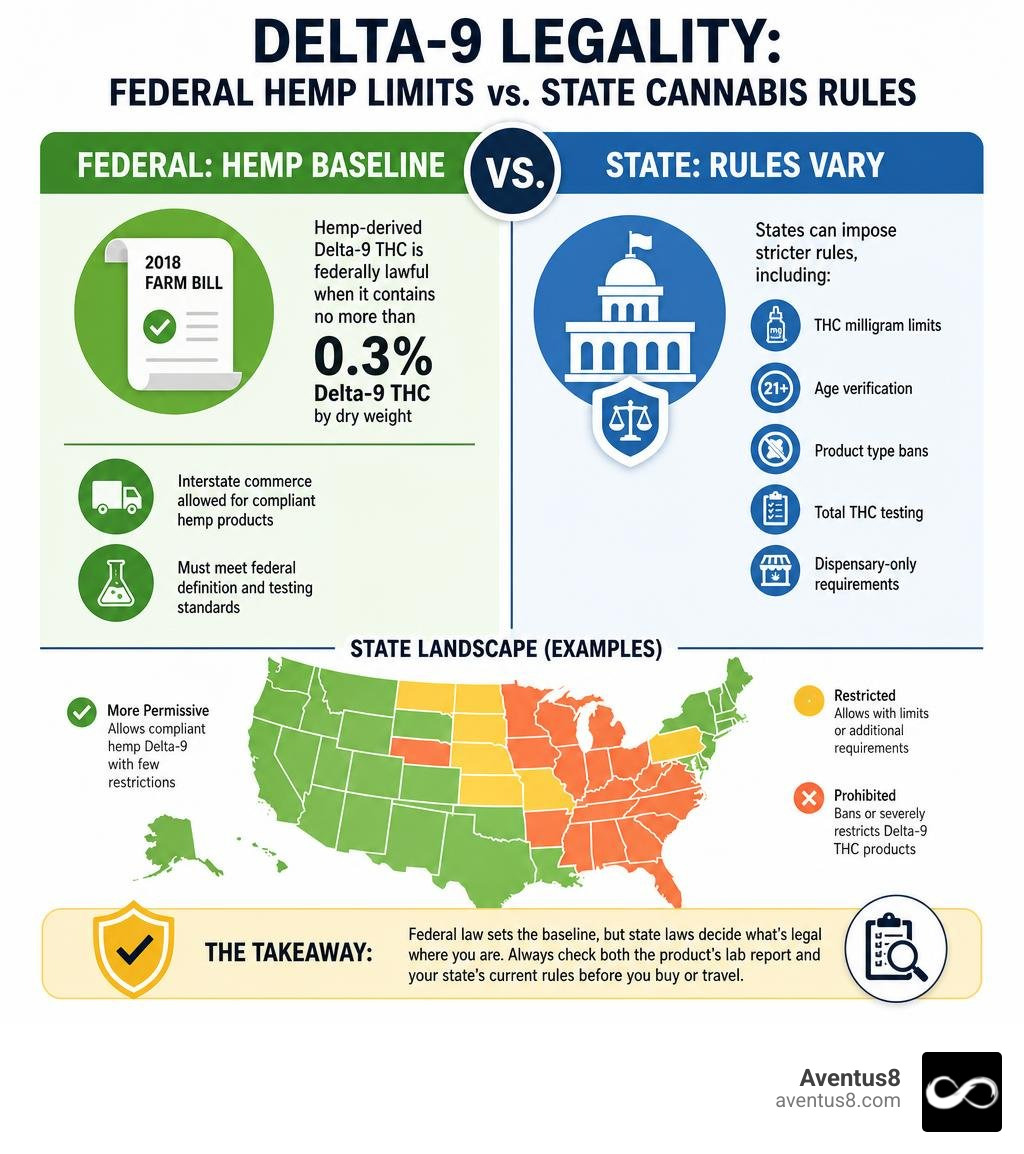
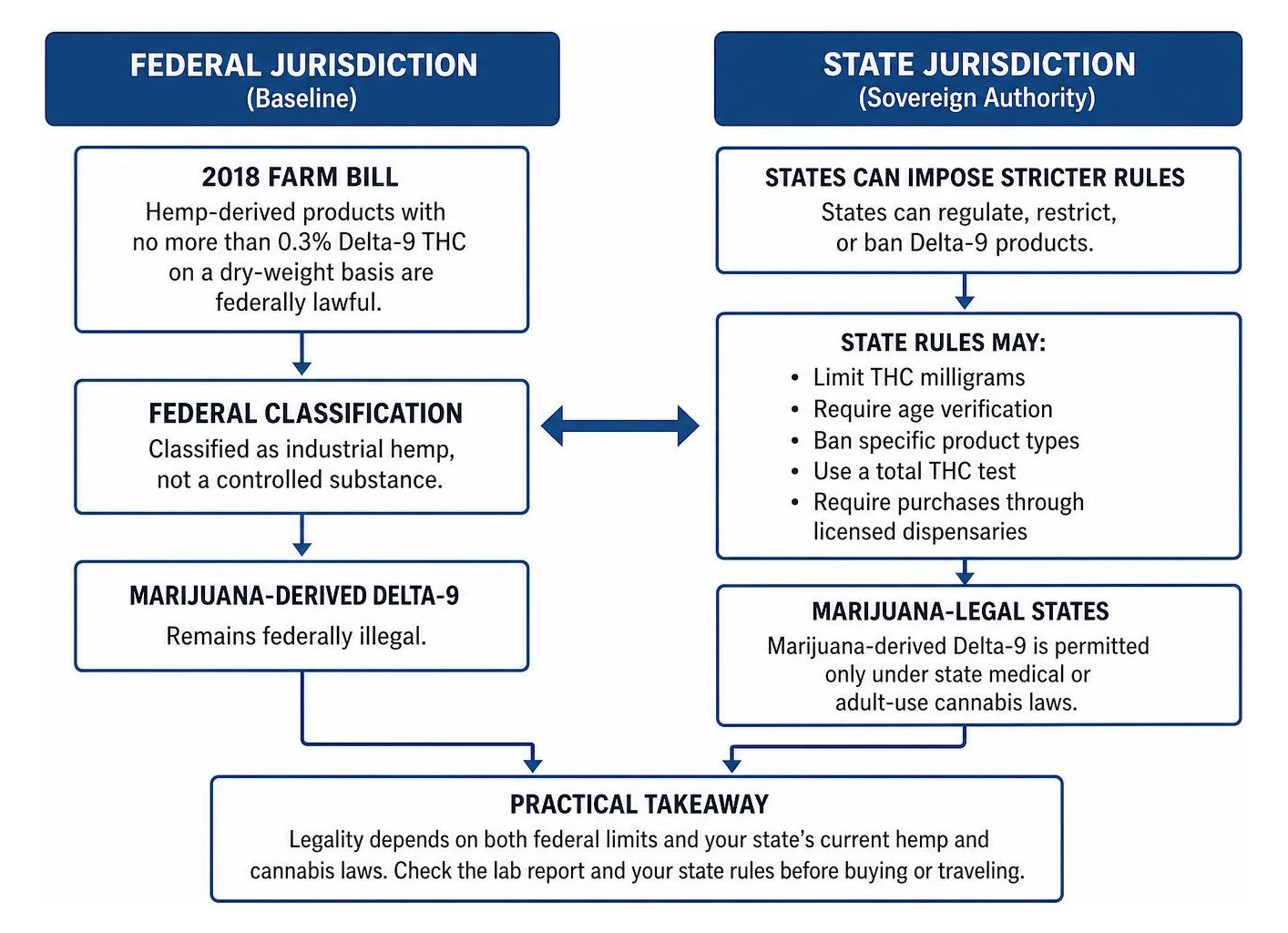
No, Delta-9 THC is not legal in all 50 states. Hemp-derived products may be federally lawful when they contain no more than 0.3% Delta-9 THC by dry weight under the 2018 Farm Bill, but states can impose stricter rules. Marijuana-derived Delta-9 remains federally illegal and is only permitted under certain state adult-use or medical cannabis laws.
For shoppers in Hollywood, Florida, and across the country, the practical rule is simple: check both the product's lab report and your state's current hemp and cannabis rules before ordering or traveling. Florida allows regulated medical marijuana and permits certain compliant hemp products, but those rules do not make every Delta-9 product legal everywhere nationwide.
State rules can limit THC milligrams, require age verification, ban specific product types, use a total THC test, or require purchases through licensed dispensaries. Laws are also changing quickly in 2026, especially for intoxicating hemp products.
I am Max Shemesh, founder and CEO of Aventus8, where I help hemp businesses navigate product quality and complex compliance requirements from Hollywood, FL, to nationwide markets. Understanding is delta-9 legal in all 50 states is central to helping consumers make informed choices about compliant cannabinoid products.
Is Delta-9 Legal in All 50 States? Understanding Federal and State Classifications

Navigating the landscape of cannabis law requires understanding the separation between federal baseline statutes and state sovereign powers. While federal legislation sets the ground rules for interstate commerce and agriculture, individual states possess broad authority to regulate, restrict, or outright ban specific consumer items within their borders.
Is Delta-9 Legal in All 50 States Under the 2018 Farm Bill?
The modern hemp marketplace owes its foundation to the 2018 Farm Bill (the Agriculture Improvement Act), which formally differentiated low-THC hemp from controlled marijuana. Under federal statutory definitions, cannabis containing no more than 0.3% Delta-9 THC on a dry-weight basis is legally classified as industrial hemp rather than a controlled substance.
This mathematical definition opened the door for consumable hemp formulations. Because edibles, gummies, and beverages carry physical mass, a product can contain 10mg, 25mg, or more of naturally extracted Delta-9 THC while remaining below the 0.3% threshold by dry weight. Policy researchers examining state frameworks, such as those documenting Mapping Hemp Products' Legal Status Across US States - Baker Institute, have noted that weight-based metrics created an expansive market for naturally derived cannabinoid consumables.
To explore the pharmacology and plant biology behind this classic compound, check out Delta-9 THC: The Ultimate Guide to Cannabis Key Compound. Additionally, comparing raw acid precursors with active cannabinoids in THC-A vs Delta-9: Which One Is Right for You helps clarify how dry-weight potency calculations operate in compliance testing.
How Delta-9 Differs From Delta-8 and Other Cannabinoids
While Delta-9 is the primary, naturally occurring psychoactive cannabinoid found in mature cannabis, the market also features isomers such as Delta-8 THC. Delta-8 occurs naturally in minuscule amounts, meaning commercial products generally rely on chemical conversion (isomerization) from hemp-extracted CBD.
The functional distinctions, user experiences, and chemical profiles of these compounds are explored in Delta-8 vs Delta-9: Biggest Differences. Because Delta-8 involves chemical conversion, it faces distinct scrutiny under DEA synthetic-cannabinoid definitions and state-level isomerization bans. The nuances between direct plant extraction and laboratory synthesis are detailed in Delta-9 THC Natural or Synthetic? Here's What You Need to Know.
Federal Updates and H.R. 5371 Enforcement in 2026
As of August 2026, federal oversight is shifting rapidly. The introduction and implementation of federal measures like H.R. 5371 introduce strict "total THC" testing frameworks aimed at closing the dry-weight calculation window for heavy consumable goods. With an enforcement date set for November 12, 2026, H.R. 5371 creates a definitive timeline for manufacturers and retailers to adapt their formulations to combined THCa and active THC standards.
Tracking updates through industry monitoring tools like the Delta-8 THC Legality Map 2026: State-by-State Guide | HempData highlights how quickly legislative sessions alter product availability. These changes reflect ongoing debates surrounding federal scheduling, as covered in The Controversy of Schedule 1 Drug Classification.
State-by-State Breakdown: Recreational, Medical, and Restricted Regulations
Cannabis governance across the nation is divided into distinct regulatory models. Understanding which category your jurisdiction falls under ensures you remain fully compliant when ordering or possessing products.
Adult-Use and Medical Cannabis States Across the Nation
Across the country, 22 states plus the District of Columbia permit recreational, adult-use marijuana alongside hemp products, while 15 states maintain medical-only cannabis programs. In adult-use states, consumers 21 and older can access dispensaries and purchase Delta-9 products without patient registration. In medical-only states, access to marijuana-derived Delta-9 requires physician certification and state-issued registry cards.
For an in-depth breakdown of local Sunshine State rules, explore Is Marijuana Legal in Florida.
| Regulatory Category | Number of States | Typical Framework & Access Model |
|---|---|---|
| Recreational / Adult-Use | 22 States + D.C. | Regulated retail dispensaries for adults 21+; parallel compliant hemp retail permitted. |
| Medical-Only Programs | 15 States | State registry required for marijuana Delta-9; select low-THC hemp products allowed by statute. |
| Restricted / Low-THC Only | 11 States | Non-medical marijuana prohibited; strict milligram caps, total THC limits, or CBD-only rules. |
| Prohibited / Zero Tolerance | 2 States | Broad bans on intoxicating cannabinoids and total-THC calculations for all hemp products. |
States Restricting or Banning Hemp-Derived Intoxicating Cannabinoids
Approximately 11 states strictly restrict or prohibit consumable hemp-derived intoxicating cannabinoids. These jurisdictions often implement total THC calculations (combining Delta-9 and THCa), impose per-serving milligram limits (such as 2mg to 5mg per serving), or restrict sales exclusively to state-licensed cannabis dispensaries.
Regional legal perspectives on legislative progress in neighboring jurisdictions can be found in our reviews of whether Is Alabama Legalizing Weed and whether Is Tennessee Legalizing Weed.
Why Is Delta-9 Legal in All 50 States for Low-THC Formulations but Locally Regulated?
In Florida, including our home base across Hollywood, Miami, Miami-Dade, and Broward County, the Florida Department of Agriculture and Consumer Services (FDACS) maintains clear oversight over consumable hemp. Products must adhere to strict 0.3% Delta-9 dry-weight limits, clear age-gating (21+), comprehensive third-party lab testing, and tamper-evident packaging.
To understand how Florida manages hemp extracts and edibles locally, see Full Spectrum CBD in Florida: What's Legal, What's Not, and Why You Should Care and our detailed review of Legal Edibles Florida.
Interstate Travel and Transport: Flying and Driving with Delta-9
Transporting cannabinoid products across county or state lines requires attention to federal jurisdiction and motor vehicle safety standards.
Flying with Hemp vs. Marijuana Delta-9 Products
Commercial aviation falls under federal jurisdiction governed by the Transportation Security Administration (TSA) and the Federal Aviation Administration (FAA). TSA screening procedures focus on aviation security and threats rather than searching for personal cannabis. However, if federal officers discover cannabis items during screening, they evaluate compliance based on federal law.
Federally compliant hemp products containing no more than 0.3% Delta-9 THC on a dry-weight basis are legal to transport across state lines under the 2018 Farm Bill. When traveling, always carry product packaging with an accessible QR code linked to a verified Certificate of Analysis (COA).
To understand traveling without dispensary credentials, read No Medical Card Needed and Going Green Without the Card: What You Need to Know.
Driving Laws, Impairment, and Legal Penalties
While possessing compliant hemp in your vehicle is lawful across non-prohibited states, operating a motor vehicle while impaired by Delta-9 THC is strictly illegal in all 50 states. DUI and DWI statutes make no distinction between federally compliant hemp-derived Delta-9 and dispensary-purchased marijuana.
Law enforcement agencies utilize field sobriety tests, drug recognition experts, and chemical toxicology screenings to assess driver impairment. Open container regulations in many jurisdictions also apply to unsealed cannabis packaging kept within the passenger cabin of a vehicle.
For guidance on responsible use and systemic processing times, review Delta-9 THC Legal Status and Safety Concerns along with our guide on Clearing Delta-9: Understanding Its Duration in Your System and Quick Detox Tips.
Frequently Asked Questions About Delta-9 THC Legality
Can consumers legally buy Delta-9 gummies online without a medical card?
Yes. Consumers nationwide can legally purchase hemp-derived Delta-9 gummies online without a medical card, provided the gummies contain 0.3% or less Delta-9 THC by dry weight and their destination state permits hemp consumables.
Reputable online retailers enforce 21+ age verification at checkout and ship lab-tested formulations directly to residential addresses. To find top-rated edible selections, consult Delta-9 Gummies: Your Guide to Ordering the Best.
What penalties apply if caught with Delta-9 THC in restricted states?
In states that prohibit intoxicating hemp derivatives or restrict Delta-9 to medical programs, possessing non-compliant products can lead to misdemeanor or felony controlled substance charges. Penalties range from civil fines and mandatory drug education to probation or criminal record entries depending on the total weight possessed.
Learn more about molecular definitions and legal classifications in Delta-9 vs THC: What's the Real Difference.
How do consumers verify if a Delta-9 product is federally compliant?
Federal compliance is verified by reviewing a product's batch-specific Certificate of Analysis (COA) issued by an ISO 17025 accredited third-party laboratory. The COA must show a Delta-9 THC concentration of 0.3% or less by dry weight, confirm potency, and pass safety screenings for pesticides, heavy metals, residual solvents, and microbials.
For step-by-step guidance on evaluating lab reports and product quality, check our Top Delta-9 Gummies Reviews and Buying Guide.
Conclusion: Navigating Delta-9 Legality and Safe Nationwide Purchasing
Understanding Delta-9 legality comes down to knowing the source of the compound, total dry-weight concentrations, and the evolving regulations of your home state. While marijuana-derived Delta-9 remains restricted to specific state medical or adult-use frameworks, Farm Bill compliant hemp formulations offer a legal, accessible alternative for consumers across the country.
At Aventus8, we operate our fulfillment hub out of Hollywood, FL, distributing premium, lab-verified cannabis and hemp products to customers in Miami-Dade, Broward County, and non-restricted markets nationwide. We believe in transparency, safety, and straightforward access. Every product we provide is rigorously tested by independent laboratories, Farm Bill compliant, and available with no medical card needed.
Enjoy free shipping and a free gift on all orders over $75 delivered directly to your door anywhere in our nationwide delivery network. Interested in working with an industry leader? You can also earn through our dedicated affiliate program.
For further regulatory analysis and state-specific policy guides, review our comprehensive deep dive on navigating delta-9 laws where is it legal.